
I’ve always found New Year’s resolutions to be a very strange thing. They weren’t something that was frequent in my family, and I have never met anyone who made one, and actually stuck to it. However, I decided to make one myself this year: read 52 books in 2022. 52 – you’ll have realized if you’re a numbers’ fan as I am – is not a random number: it’s roughly one book per week (it’s pretty fun to tell people the number and see if they realize the reason or not). There’s no particular genre, nor length. I’ve read skinny books that let me rest a bit, and thick books that I need to plow through. Novels and memoirs, business and self help books, everyone’s welcome.
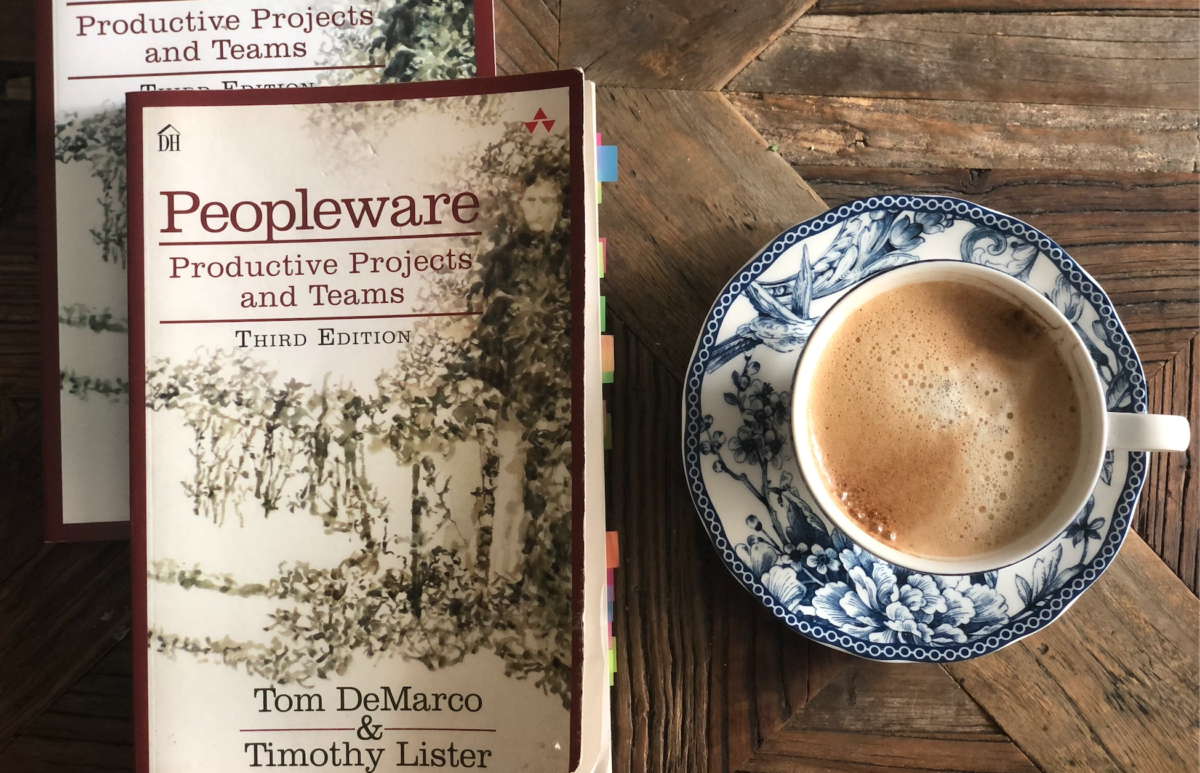
My second goal – slightly more altruistic – is to try and share some learnings from the ones I particularly like. So, this first post is going to be related to a book that our CEO Maximo recommended (and lent): Peopleware: Productive Projects and Teams, by Timothy Lister and Tom DeMarco. Fun fact, there were two copies in the office, so my husband and I were reading it at the same time (we started it at the same time… but it wasn’t a race. Else I would’ve won. Duh).
With such a title, I have to admit I expected a pretty boring book. I looked at it sitting on my nightstand, looking so smug, half bitten by Maximo’s dog… it didn’t look too tempting. What can I say, I’m a living cliche: judging a book by its -bitten- cover. 240 pages later, I’m reminded of the truth of that saying. I half-filled it with markers and post-its to discuss it with the team, and I actually laughed out loud at some of the truths I found inside its pages. Here are some of my takeaways:
Project Management
The first concept that made me laugh was Parkinson’s Law: “work expands to fill the time allocated for it”. Written by a humorist, I thought about how many times we’ve said: “there’s no time for this”, or, “since we have the time, let’s do this or that”. As a developer, lead, manager, sometimes it feels like our teams will always need more time for a certain project, so is it possible that the allotted time influences how we do things?
Engineering Management
As I’ve transitioned from more technical to managerial roles, I’ve often wondered what’s the real job description of a manager. I loved the definition given in the book: “The manager’s function is not to make people work, but to make it possible for people to work”. Removing obstacles, helping teams jell (another hugely important concept – how to help teams work well together, cooperate, and become a unit), identifying key players and their role, allowing people to attain a state of flow (that magic moment where you’re in a deep, almost meditative involvement, and are able to make code “flow” from your fingers – you know what I mean).
Another aspect of management is to help people improve. This can be providing opportunities for private self-assessment, to conducting thorough 1x1s with teams. Maybe even having in-house aptitude tests for people to self-assess objectively, and compare with what they thought of themselves beforehand. This ties hand-in-hand with another concept that the book mentions: everyone wants to work in teams that do things with high quality. Helping people improve also works towards that goal.
Finally, I loved this phrase: “the ultimate management sin is wasting people’s time”.
Team diversity
Another moment that made me laugh was when the authors said: “The ‘class picture’ you take of your next project team is likely to show something that looks more like a United Nations task force than the kind of single-culture group that our fathers and grandfathers managed”. That made me reflect about the importance of diversity, and how that helps teams. The authors also make a point for diverse teams, with different genders, orientations, backgrounds… It’s something we strive for, and it’s great to read that our instincts are correct.
Hiring, training and coaching
Our interview process often includes an interview with future team members. On the one hand, this goes against favoring “flow”, because it adds one more meeting to our folks. On the other hand, it’s mentioned as one of the best ideas for hiring: testing how (potential) future colleagues will work together. It’s a beautiful thing to witness great work relationships being born in an interview, with interviewer and interviewee jamming together.
Once they’re hired, as part of my role as VP of Engineering, my job is to train the new hires (and sometimes retraining people with varied backgrounds). When I mentioned that to my friends, they were shocked – almost as if they thought that it was a waste of my valuable VP time. However, as part of a section called “The Right People”, the authors mention the importance of training and retraining people, and how at Hitachi Software, the chief scientist has as his principal function the training of new hires – and they’re not the only ones. So, if we’re crazy, at least we’re in good company.
After being trained and successfully deployed into teams, it’s important to continue coaching our team. It can be both peer-coaching or it can be someone in higher management, but it’s important to have someone that holds us accountable to our long term personal and professional growth. Again, similar to 1x1s, it takes time. But things that are worthwhile usually do. Having teams that build satisfying communities, and care about coaching, career progress and learning are the ones that build satisfying communities and tend to keep their people.
Meetings
It’s important to try to have good meeting hygiene: only the necessary people, try to make them as short as possible, and be able to know when they’re done (decision made, agreement reached, etc). Having too many people (who often don’t speak) just to FYI them, makes no sense. If you have a status meeting, try to have it adding value to all attendees, not just the manager. And be very careful with recurring meetings: often they are not necessary (except ceremonies).Finally, if we have a “working meeting” – what does it say of the rest?
Change and learning
Learning is a critical improvement mechanism – those who don’t learn can’t expect to prosper. Often, middle managers are the ones proposing changes and the ones that have the chance to be close enough to the action to learn from mistakes. It’s important to be very attentive to what they say, and to empower them to drive change. Also, change will often have hard detractors and lukewarm supporters – but also people who are believers but questioners: managers should try to identify them, and try to bring them on board. They’re the best chance for the project to succeed.
Chaos
Usually, engineers tend to have problem solving minds, and that makes us value a little bit of chaos: it’s what gives us adrenaline. Working on problems that are already solved, and we can only have limited impact… kinda crushes our soul. So it’s a good thing to try and have some space for chaos (crazy projects, or proofs of concept where we can run wild), because they make us feel alive and challenged.
All in all, this was definitely not a poolside book for January. The thinnest book of 2022 so far, and the one that took me the longest to read, because it made me stop, reflect, highlight… I couldn’t read more than two chapters per sitting – which is pretty bad for my yearly goal, but shows that sometimes, less is actually more!